3D: how it gives industrials and manufacturers a competitive edge
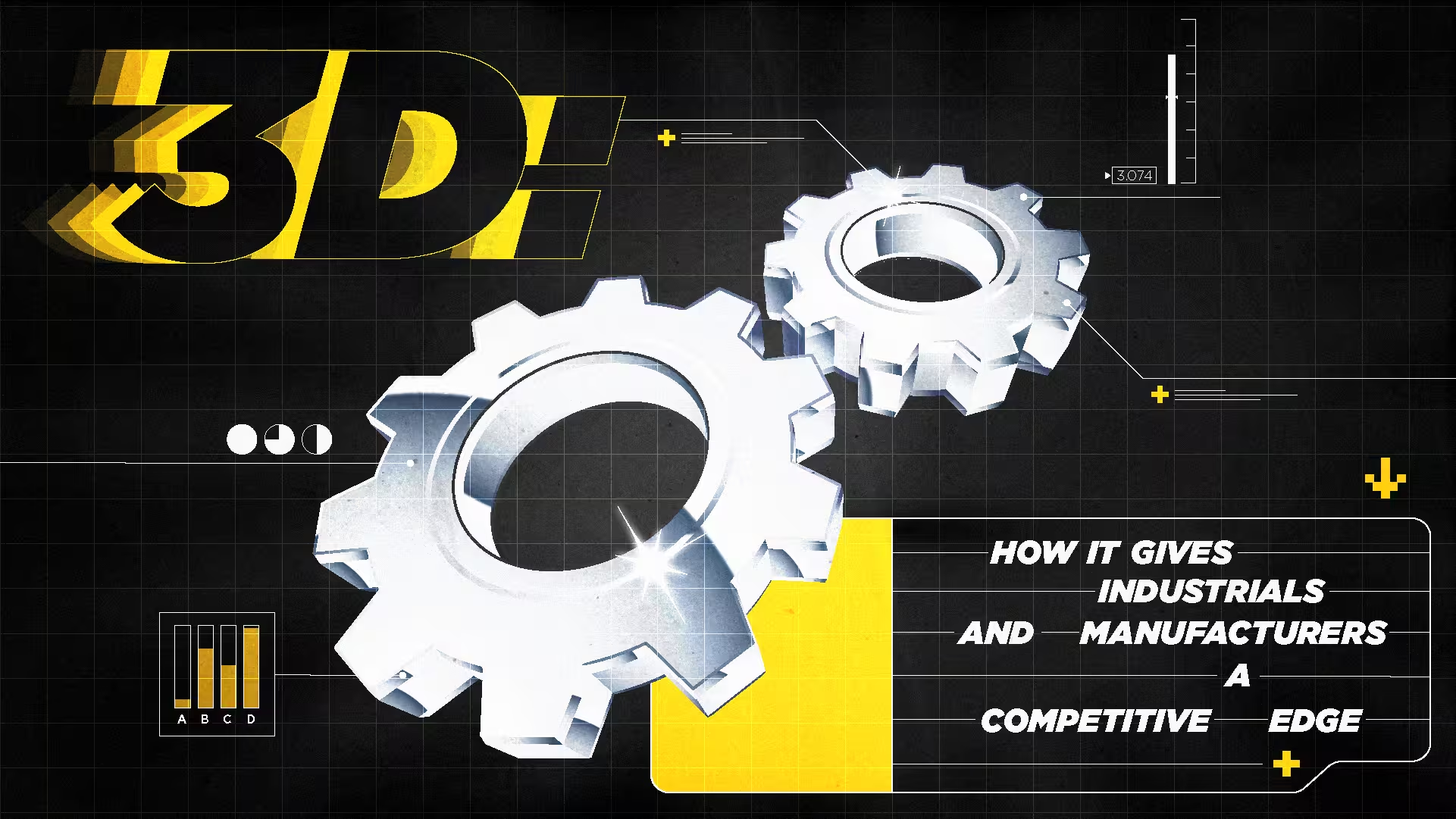


Complex products deserve more than flat photography. They’re incredible pieces of engineering that need showcasing in the right way. But in the industrial and manufacturing world, your innovations are often hidden deep inside larger systems, sealed within housings, or simply too large, too dangerous, or deployed too remotely to film. Yet you still need to explain them clearly, quickly, and convincingly.
That’s where 3D can give you a competitive edge. Today’s buyers expect clarity. They expect interaction. They expect to see how something works, not just read about it. 3D empowers us to tell those stories with precision, creativity, and control.
Why 3D should already be in your marketing toolkit
For industrial and manufacturing brands, 3D solves challenges that photography or traditional video often can’t, by:
- Clarifying complex engineering instantly
- Communicating invisible features and internal mechanisms
- Reducing dependency on physical prototypes
- Making remote selling significantly easier
- Creating reusable content pipelines
- Standardising visuals globally across teams
- Future-proofing your digital presence
In essence: 3D helps technical buyers understand technical products fast. Let’s explore its advantages in a bit more detail.
The clarity advantage: explaining the invisible
Few tools can simplify complex engineering like 3D. It lets us break products down, cut them open, ‘ghost’ them out', and show exactly how they function inside a wider system. Our long-term partnership with Trelleborg’s Antivibration Solutions (AVS) team has allowed us to demonstrate this first hand. Their polymer-based anti vibration products sit deep inside machines – trains, wind turbines, construction vehicles – and a standard photo rarely tells the full story.
So, we built a visual language for them – cutaways, sectional reveals, exploded views, and internal ghosting, all rooted in technical understanding.
Behind every image is hours of engineering alignment — CAD clean-up, material verification, consulting with product experts, and stress-testing the logic of each component’s behaviour. The final imagery isn’t just beautiful; it’s accurate enough for an engineer to trust.
This blend of aesthetics and precision is the superpower of 3D.
When filming is impossible: tell the story with 3D
Some products are too remote, too large, too small, too new (there may not be prototypes yet), or simply not available to film. That shouldn’t stop a great launch.
Take Trelleborg’s Capital Markets Day or Panasonic’s TOUGHBOOK 40 launch, we created 3D animations that:
- Replaced costly location shoots
- Visualised components not yet manufactured
- Enabled impossible camera angles
- Delivered global-ready assets without physical limitations
In cases like these, 3D isn’t just a cost-efficient planB: the creative opportunities expand the moment we leave the constraints of a physical set. We can move inside machines, slow time, highlight stress forces, colourise airflow, or reveal sub-surface layers.
When we moved offices in Bristol, 3D proved its worth long before the first builder arrived on site. Using nothing more than blueprints, flooring samples, timber finishes and paint swatches, we created a 3D walkthrough of the new workspace. That virtual tour didn’t just help us imagine the space - it let us test it, refine it, and make confident design decisions before a single fixture was installed.
The result? Crucial layout changes made early, zero expensive surprises later, and a final space that worked exactly how we needed it to. It’s a perfect example of how 3D removes risk, accelerates decision-making, and gives you clarity long before the real world catches up.
Interactive 3D and augmented reality (AR)
As digital expectations rise, industrial buyers want more than glossy images. They want to be able to control a product, rotate it, zoom in on it, explore hotspots. Maybe even drop it into their workshop using AR.
That’s why we love combining interactive 3D with lightweight frameworks like Google <model-viewer>. It’s fast, device-friendly, and incredibly efficient for turning CAD into a real-time product experience.
<model-viewer> gives us:
- A clean, well-supported 3D viewer
- Touch-friendly interaction
- Hotspot annotations
- Minimal code overhead
Clients often have half the work done already because they have CAD files. We optimise them, create PBR materials, and plug them straight into the browser.
Case study: Epson’s desktop scanner
We optimised Epson’s manufacturing model using AI-assisted decimation (which reduces the polygon count), then added materials and built a fully interactive 3D and AR experience — all in under 240 lines of code.
Fast to build, lightweight to run, and impressive on any device. This is where marketing, sales enablement, and product training start to merge: a single 3D asset doing the job of many tools.
The main takeaway?
If your product is complex, 3D makes it understandable.
If it’s hidden, 3D makes it visible.
If it’s unavailable, 3D makes it real.
And in a world where your competitors are fighting for attention, clarity and control are advantages worth investing in.
If you want to explore turning your CAD into imagery, explainer videos, or interactive assets, we’d love to talk. You can drop us a line at marketing@proctorsgroup.com